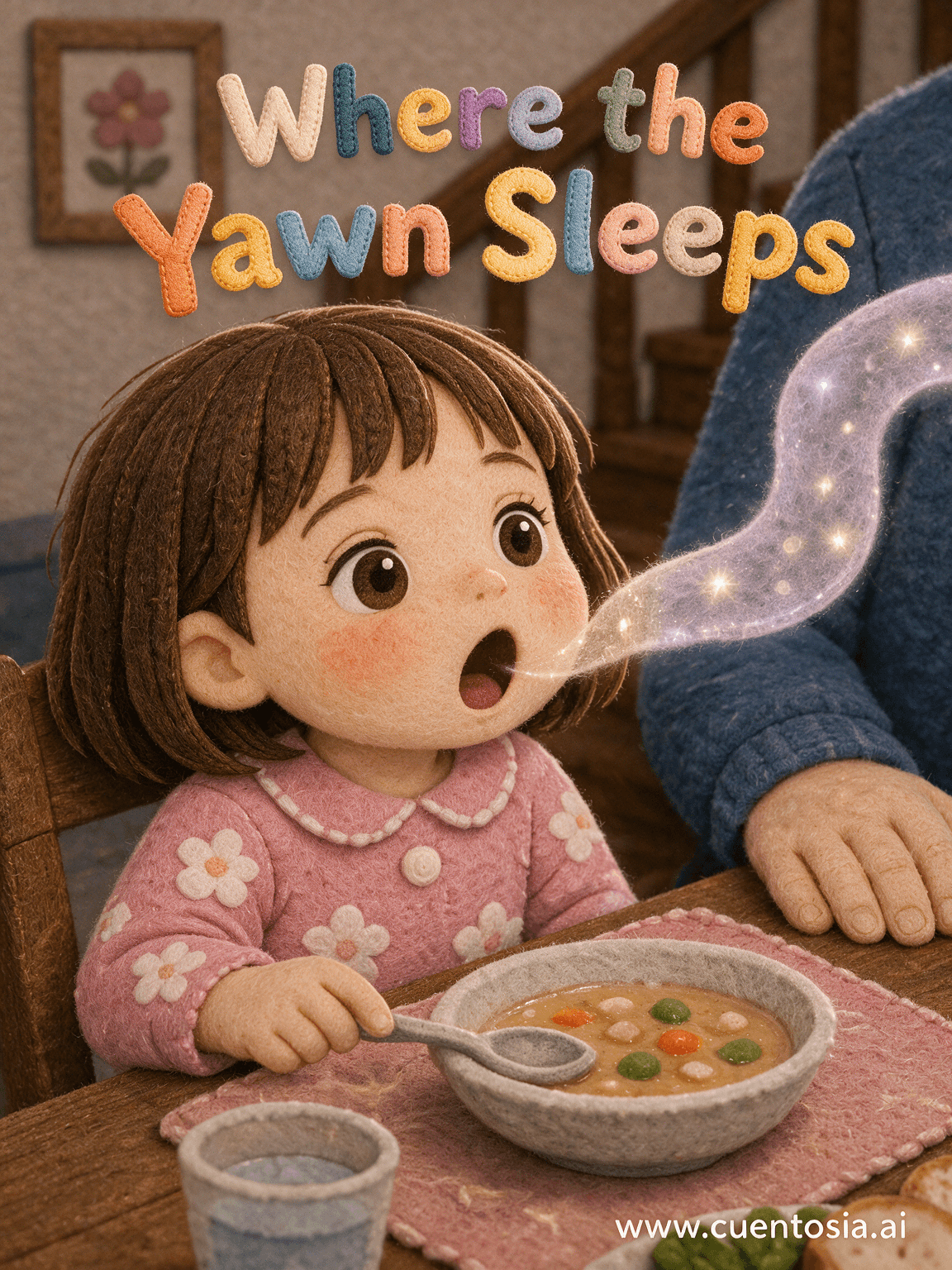
At dinner, Sofía lets out a small yawn, and instead of disappearing it goes travelling through the whole house, turning lights soft and voices low. She follows it on tiptoe to find out where yawns go to sleep.
Your first 12-page digital story is free when you sign up. The printed edition is purchased separately.
Bedtime story · Ages 2-5
Where the Yawn Sleeps begins at the dinner table, when three-year-old Sofía lifts her spoon, opens her mouth wide and lets out a small yawn, soft as warm milk. Instead of vanishing, the yawn floats above the plates and waits for her. It gives one sleepy sway and drifts toward Dad, and Sofía asks the question that sets the whole book in motion: where are you going?
From there the yawn goes travelling, and the house grows quieter behind it. Dad catches it with one long breath and his voice drops low. It stretches across the floor to brush the cat's nose, and the cat tucks its paws close and purrs. Then it climbs the stairs, making the light softer on every step while Sofía follows, holding the rail, until even her little footsteps turn hushed. Down the hallway it slips past one door, then another, peeking into every corner and leaving a patch of calm behind.
This is a bedtime story for 3 year olds in the most literal sense: seven short pages, each one slower and quieter than the one before, written in simple sentences a sleepy toddler can follow lying down. Ideal for ages 2 to 5 as the very last story of the night, at home or in a nursery wind-down routine, when what you want is not an adventure but a soft landing.
A bedtime story in which the yawn does the walking
Most bedtime books ask a child to go to sleep. Where the Yawn Sleeps does something gentler: it lets a yawn lead the way and simply asks Sofía to follow. The yawn escapes at dinner, hops to Dad, brushes the cat, climbs the stairs and wanders the hallway, and everywhere it passes the lights go soft and the voices go low. Sofía, three years old and wide awake at page one, walks after it on tiptoe.
The mechanic is the whole point. Because the yawn moves from person to person, the reader is not being told to calm down; the house calms down first, room by room, and the child comes along for the ride. By the time the yawn circles Sofía's pillow, once and then twice, the story has already done the settling. Seven pages, no conflict, no villain, no twist: just a house getting sleepier.
It began with a spoon halfway to her mouth, and one very small yawn.
What a two to five year old takes from it
At this age a story does not need a lesson so much as a shape, something the child can predict and lean into. This one gives them a chain they can follow with their finger and repeat back on the second reading. The learning is quiet and practical, and it happens while they are already lying down.
Sleepiness is contagious, and that is fine. Dad yawns, the cat yawns, and Sofía does too, so being tired reads as something shared rather than something imposed.
A predictable pattern to hold onto. The yawn goes somewhere, that place gets quieter, Sofía follows. Toddlers can anticipate the next page, which is exactly what makes a bedtime book work.
Volume as part of the story. The text itself drops from a question to a whisper, giving the grown-up reading aloud a built-in cue to slow down.
A gentle ending to the day. The last thing that happens is a blanket, a doorway and a whispered goodnight, with no cliffhanger to keep small minds busy.
Sofía followed more slowly now. Do yawns sleep here? she breathed. The yawn went on, rocking like a tiny boat at night.
Even the cat could not resist it, and the floor went quiet.
Now picture it with your own child's name
Half the magic of a bedtime story at three is recognition, and nothing lands harder than hearing your own name from the page. With cuentosIA you can turn this same slow, whispery idea into a book where the yawn escapes at your dinner table, climbs your stairs and curls up in your child's real bed, with a main character who has their face, their hair and their favourite pyjamas.
The supporting cast can be yours too: the grandparent who always does bedtime, the older sibling down the hall, the family dog who is genuinely asleep already. A child who finds themselves inside the book tends to ask for it again the next night, which is precisely what you want from a bedtime routine.
How it works
Upload a photo of your child and tell us a little about them.
Choose the illustration style, the tone and the age you are reading to.
In a few minutes your story is ready to read online, download as a PDF or order as a printed book.
Why it works as a gift
A personalized bedtime book is one of the rare presents that gets used every single night rather than once. For a third birthday, a new bedroom, a first big-kid bed or a christening, it arrives as an object the child can point at and say that is me, and it slots straight into a routine the family already has.
It also travels well between households. Grandparents, an aunt who visits on Sundays, a nursery keyworker: anyone who reads to the child can pick it up, and the story explains itself in one page. Printed, it becomes the book that gets a little more worn each year.
Down the hallway it went, leaving a patch of calm in every corner.
Is it short enough for a three year old?
Yes. It runs to seven pages of a few short sentences each, which is roughly four or five minutes read aloud at a slow bedtime pace, and less if your child is already halfway gone.
Is there anything frightening in it?
Nothing at all. There is no villain, no problem to solve and no dark to be afraid of. The stairs and the hallway are lit and warm, and Dad and the cat are nearby the whole way.
Can I read it for free?
You can read the complete story right here on this page, with every illustration, at no cost and without signing up.
Turn this quiet goodnight into a book with your child's face and name.