Noah is four years old. You're in the supermarket, he's on the floor, and the noise coming out of him doesn't have a name yet — not for him. He isn't being naughty. He's overwhelmed, and he has no words for it. That moment — the wordless overwhelm — is exactly when stories become a child's most powerful emotional tool.
Children feel with the same intensity as adults, but without the language or experience to understand what is happening inside them. Stories offer something uniquely powerful: a safe place to witness an emotion, learn its name, and discover that someone else has felt it too.
This guide moves through the key emotional stages of childhood — starting with the ages that matter most for school readiness, then working outward — and shows how stories, particularly personalised ones, can support your child's emotional world at every step.
Why stories are the best tool for emotional literacy
When a child hears a story, something remarkable happens in the brain: the same regions activate as if the child were living the experience in person. That capacity to safely "inhabit" a character's emotional state is what makes stories such a powerful vehicle for emotional learning.
A study published in First Language found that children who read personalised stories — where they are the protagonist — retain significantly more emotional vocabulary and engage more deeply with the narrative than those reading generic versions.
Stories work on three fundamental levels:
Identify: the child recognises an emotion in the character before recognising it in themselves. "That's what I feel when..."
Name: putting a word to an emotion is the first step towards managing it. A child who can say "I'm frustrated" has far greater capacity for self-regulation than one who can only cry or shout.
Normalise: discovering that a beloved character also feels fear, sadness or anger sends a powerful message: what you feel is completely normal, and you are not alone.
This aligns directly with the emotional literacy goals of England's PSHE curriculum and the Early Years Foundation Stage (EYFS), which identify the ability to recognise and name feelings as a core developmental outcome. The Anna Freud Centre highlights that early emotional literacy — the ability to label and talk about feelings — is one of the strongest protective factors for children's long-term mental health, particularly given the pressure on CAMHS services across the UK.
The key emotions of childhood and when they emerge
Not all emotions arrive at the same time. Understanding the developmental sequence helps you choose the right stories for your child's current stage.
Basic emotions (present from birth)
Joy, sadness, fear, anger and surprise are present from the first months of life. They are innate, adaptive responses: fear protects, anger sets limits, sadness calls for comfort. Between 0 and 2 years, babies express them instinctively; from 2 to 3 years, children begin to identify and name them with adult support.
Social emotions (from around 2-3 years)
With the emergence of the self — the awareness of being a separate person — more complex emotions arrive: shame, jealousy, guilt and pride. These emotions require the gaze of another to exist and are closely tied to self-esteem.
Complex emotions (from around 5-6 years)
Frustration, deep empathy, nostalgia, anticipatory anxiety and gratitude require a degree of cognitive maturity. Children begin to experience these consciously between 5 and 7 years, though their management continues to develop well into adolescence.
Stories by age: a guide from 2 to 12
Ages 4-6: building the emotional vocabulary
This is the age of school entry — Reception and Year 1 in England — and emotionally it is one of the most significant transitions a young child will face. New relationships, new rules, and new expectations arrive all at once. The EYFS Personal, Social and Emotional Development strand makes emotional literacy an explicit goal at this stage.
Emotions to explore:
Empathy Shame Pride Frustration Fear of not fitting inBetween 4 and 6, a crucial cognitive leap takes place: the development of theory of mind — the understanding that other people have thoughts and feelings different from one's own. Stories become the ideal vehicle for growing empathy.
Shame arrives strongly when children begin comparing themselves to peers. Stories where a protagonist feels different but discovers that difference is valuable are deeply reassuring. Frustration intensifies as expectations grow: stories where characters try, fail and try again teach resilience without lecturing.
Build the habit of "reading emotions" in illustrations. Point to secondary characters and ask: "How do you think this character feels? Why?" This trains the ability to read emotional cues in others — a core PSHE skill.
Ages 2-3: the first feelings
This is one of the most emotionally intense stages of early childhood. Tantrums, sibling jealousy, the first night fears and the battle for autonomy are daily realities. Children feel with enormous intensity but have very few tools to manage what is happening inside them.
Emotions to explore:
Anger / Rage Fear Jealousy Sadness Early frustrationStories where characters "transform" when they feel an emotion are particularly effective: the monster that appears with rage, the colour that changes with each feeling, the tail that grows with anger. These visual metaphors help the child understand that the emotion is something that happens to them — not something they are.
Between 2 and 3, children begin to recognise their own name in print and to identify with images. A personalised story where the protagonist shares your child's name, appearance and circumstances has a significantly greater emotional impact than a generic one.
After reading, ask simple open questions: "Have you ever felt like that?" or "What would you say to the character?" Don't force the conversation; sometimes the silence after a story is more eloquent than any discussion.
Ages 7-9: the social emotions
Children in this band can already identify basic emotions, but begin experiencing emotional blends: happy and nervous at the same time, sad and relieved simultaneously. Anticipatory anxiety and worry about the near future also appear with greater force.
Emotions to explore:
Anxiety Worry Mixed emotions Injustice Loneliness DisappointmentChildren at this age can handle more complex narratives with plot twists. Stories where the protagonist must make ethical or emotional decisions are very valuable. "Grey" characters — neither entirely good nor entirely bad — are appropriate from age 7 onwards and encourage critical emotional thinking.
This is also the stage where children in England begin the more structured PSHE programme, exploring concepts such as belonging, fairness and managing conflict. Stories that dramatise these themes provide a safe rehearsal space.
This is a perfect age for your child to start creating their own emotional stories. Suggest inventing a story about a character who feels the same as them: writing (or dictating) a story gives a sense of agency and control over their own emotions.
Ages 10-12: identity and complexity
Pre-adolescence brings a new level of emotional complexity. Children begin experiencing emotions tied to identity, group belonging and social pressure. Reading becomes a refuge where they can explore these feelings in private, without the exposure that open conversation requires.
Emotions to explore:
Insecurity Peer pressure Self-criticism First losses Academic stressLonger stories or short novels with protagonists their own age facing realistic situations. Children in this band no longer want "little kid" stories or explicit morals; they prefer to discover the lessons themselves. First-person narratives generate a particularly strong emotional connection at this age.
Respect their emotional space. Don't push them to talk about the story, but make your availability clear. Sometimes it's enough to say: "I really liked that story. If you ever want to talk about something similar, I'm here."
The 7 hardest emotions to manage (and how stories help)
🌋 Anger: the inner volcano
Anger is probably the emotion that overwhelms parents and children in equal measure. It is intense, fast and often expressed in ways that frighten the child themselves.
Anger is not bad. What can be problematic is how we express it. Feeling angry is fine; hitting, shouting or breaking things is not the right way to channel it.
How stories help: metaphors are essential. A volcano that erupts, a dragon breathing fire, a monster that grows with every shout. These images let the child visualise their anger as something external — something they can observe, understand and, in time, manage.
👻 Fear: the invisible guardian
Fear is a protective emotion by nature, but when it spirals it can significantly limit a child's life. Developmental fears — darkness, monsters, separation — are normal and temporary.
Being afraid does not mean being a coward. Everyone feels fear, including adults. Courage is not the absence of fear; it is acting in spite of it.
How stories help: stories where the protagonist is afraid and gradually faces that fear are therapeutic — they don't say "don't be scared" but rather "look how this character, who was also afraid, found a way forward."
🌧️ Sadness: the misunderstood emotion
In a culture that prizes happiness and positivity, sadness is often the most misunderstood emotion. Many children learn to hide it because they sense that "being sad isn't okay."
Sadness is necessary. It is the emotion that allows us to process losses, changes and disappointments. Crying is not weakness; it is a natural form of emotional regulation.
How stories help: stories where the protagonist is sad and the people around them allow them to be sad — without immediately trying to cheer them up — teach children that it is fine to take time to feel.
😤 Frustration: when things don't go to plan
Frustration is one of the most frequent emotions in childhood and one of the biggest triggers of tantrums. It arises when there is a gap between what the child wants and what they can achieve.
Things don't always go the way we want — and that is a normal part of life. Frustration is a signal that something matters to us, not an indicator of failure.
How stories help: stories where characters try, fail, try again and eventually reach their goal (or discover something better) are lessons in resilience delivered without a single lecture.
💚 Jealousy: the forbidden emotion
Jealousy is one of the emotions that generates the most guilt in children, because they instinctively sense they "shouldn't" feel it. This makes it particularly hard to express.
Feeling jealous is normal and doesn't make you a bad person. What matters is learning to express it without hurting others.
How stories help: stories about the arrival of a sibling, a friend having something you want, or feeling pushed aside. The best stories about jealousy don't censor the emotion — they validate it, then show a constructive path forward.
🙈 Shame: when you want to disappear
Shame appears when a child feels exposed or senses they've fallen short of what is expected. It is a powerful social emotion that, poorly managed, can deeply affect self-esteem.
Everyone has felt ashamed at some point. Embarrassing moments pass and do not define who you are.
How stories help: stories where characters experience shame but discover it wasn't as catastrophic as it felt — or where their "flaws" turn out to be qualities. Stories with gentle humour about embarrassing situations are particularly liberating.
🌀 Anxiety: the fear of "what if..."
Childhood anxiety is rising and appearing at ever-younger ages — a reality reflected in CAMHS referral data across England. Unlike fear, which responds to something concrete and present, anxiety projects into the future: "What if I fail?" "What if they laugh at me?"
The mind sometimes tells us stories that aren't real. Having a worrying thought does not mean it will happen.
How stories help: stories where characters worry about something that ultimately does not happen, or where they learn techniques to calm their "worry brain." Stories that present anxiety as an external character help the child separate themselves from it — a technique aligned with evidence-based approaches recommended by the Anna Freud Centre.
How to get the most from emotional reading with your child
Create a reading ritual
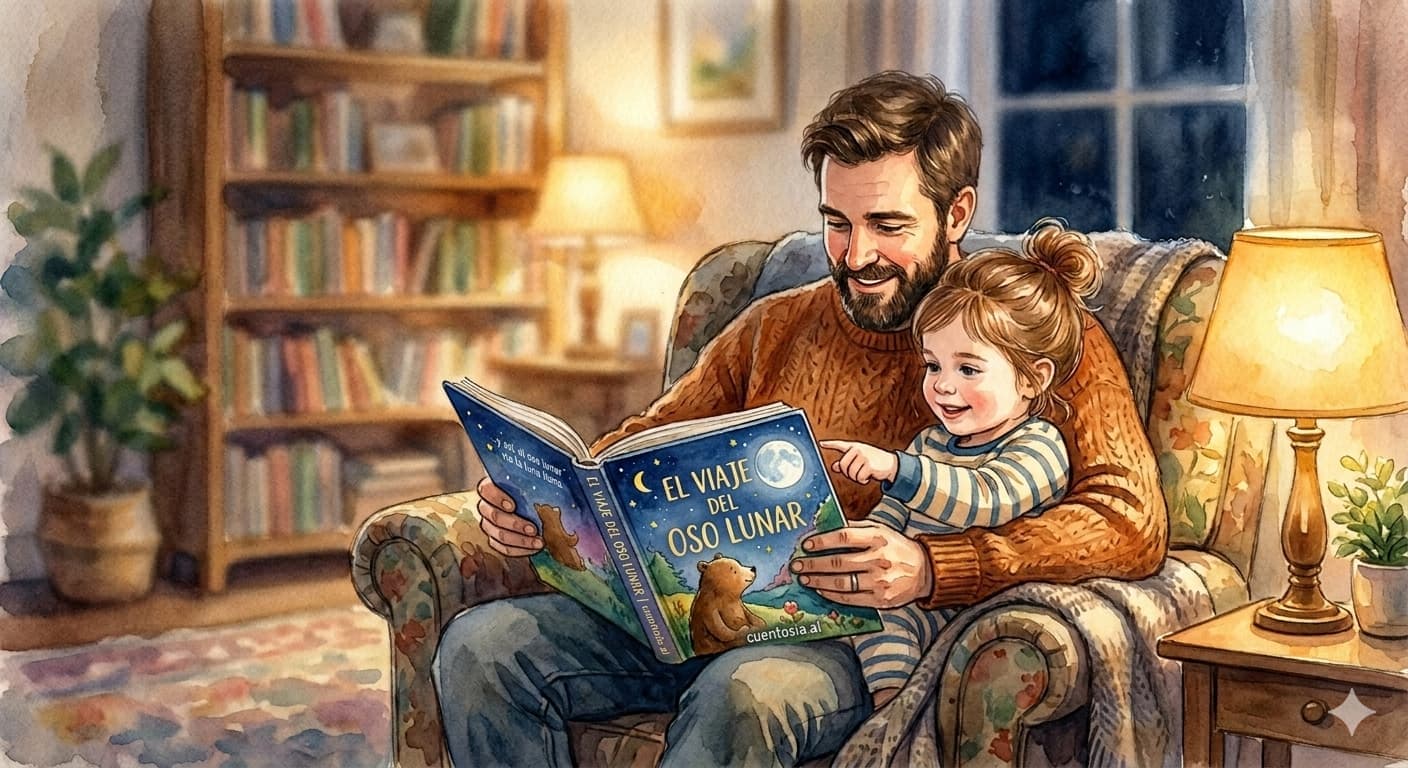
Emotional reading is not about any story read any way. It requires calm, full attention and emotional availability. The moment before sleep is ideal, but after school — when children need emotional decompression — works well too. Establish a ritual: choose the story together, sit somewhere comfortable, turn off screens and give those minutes entirely to shared reading.
Ask open questions, not interrogations
The difference between a rich emotional conversation and an uncomfortable interrogation lies in the type of question. Instead of "What did the character learn?", try "What would you have done in their place?" Instead of "Have you ever felt like that?", try "Something like that happens to me sometimes — does it happen to you?" Instead of "Why do you think they got angry?", try "What do you think they were feeling inside?"
Respect the silences
Sometimes, after an emotionally intense story, a child does not want to talk. And that is perfectly fine. The story has already done its work — it has planted a seed. The child will process the story at their own pace, and days or weeks later may make a revealing comment that shows it landed far deeper than you realised.
Repeat the favourites
If your child asks for the same story again and again, that is a sign the story is doing important emotional work. Repetition allows the child to process the emotion from different angles and with different levels of depth each time.
Let the child be the protagonist
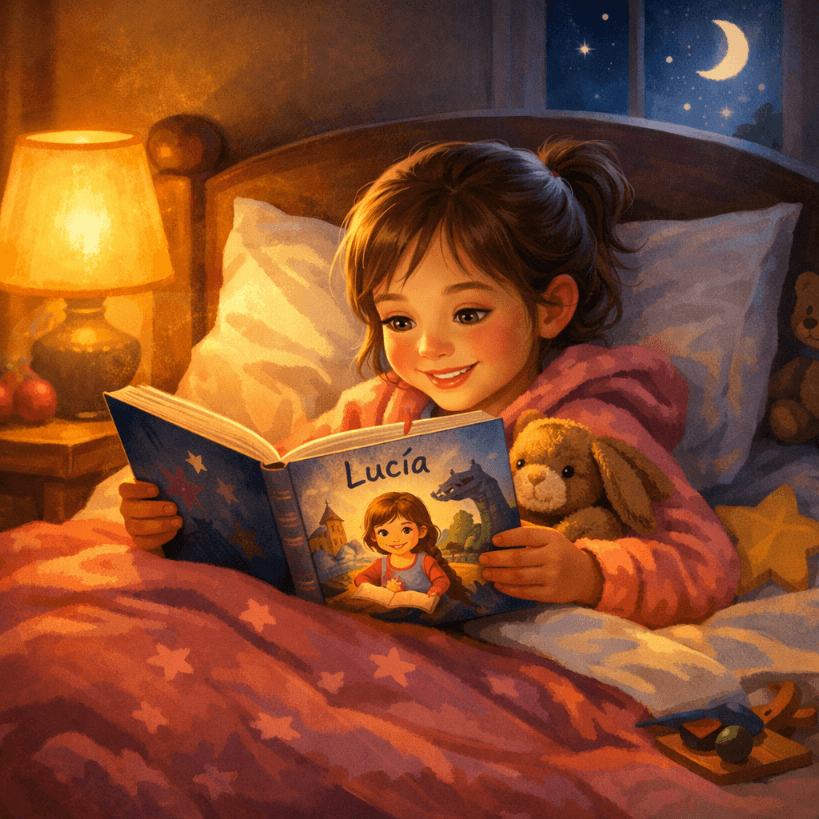
When a child sees themselves reflected in the story — with their name, their appearance, their circumstances — the emotional connection multiplies. Personalised stories have a significantly greater impact on emotional identification, vocabulary retention and subsequent dialogue between parents and children.
The science behind stories and emotions
The effectiveness of stories as emotional education tools is not merely parental intuition: it is backed by research in neuroscience and developmental psychology.
Researchers at the Open University found that children reading personalised stories spoke more freely about their feelings and focused more on their own experiences during reading — suggesting greater emotional engagement and identification.
Neuroscience tells us that stories activate brain regions linked to empathy and social understanding. When a child hears that a character feels afraid, their brain simulates that experience, building neural connections they can draw on when they themselves feel fear in real life.
Shared reading between parents and children releases oxytocin — the bonding hormone — which strengthens the secure attachment relationship. Secure attachment is in turn the foundation of all healthy emotional regulation.
Common mistakes when using stories to work on emotions
❌ Turning reading into a lesson
A story is not an ethics class or a disguised lecture. If a child senses they are being read a story "so they learn something," they will lose interest immediately. Emotional reading must above all be enjoyable.
❌ Censoring "negative" emotions
Phrases like "the character shouldn't be sad" or "look, they're happy now, it's all fine" send a dangerous message: that certain emotions are unacceptable. All emotions are valid; what can be worked on is how they are expressed.
❌ Forcing the conversation
If a child does not want to talk after a story, don't push. Pressure turns reading into an obligation and emotional dialogue into an interrogation.
❌ Choosing stories only by chronological age
Every child has their own emotional development pace. A 5-year-old may need stories aimed at 3-year-olds to work through separation anxiety — and that is perfectly fine. Age guides are indicative; your knowledge of your child is what should really guide the choice.
❌ Relying only on generic stories
Published stories are a valuable tool, but complementing them with personalised stories — where the child is the protagonist — dramatically amplifies emotional identification. When a story is about "a child" it is useful; when it is about your child, with their name and face, it is transformative.
Activities for after the reading
The story is the starting point. These activities deepen the emotional work:
The illustrated feelings journal
After reading, invite your child to draw the character's emotion and their own. Over time this journal becomes a visual map of their emotional development.
The emotions jar
Prepare coloured slips of paper (one colour per emotion) and after each story the child picks the one that represents how they feel. After a few weeks, look together at which colours appear most.
Change the ending
Ask your child to reinvent the ending: "What would have happened if the character had reacted differently?" This encourages cognitive flexibility and creative emotional problem-solving.
Act out the story
Performing scenes with toys, puppets or costumes lets the child explore the emotion from the outside — as if they were a director deciding how the characters behave.
Create their own story
The culmination of emotional work: the child becomes the author. Invite them to invent a story about a character who feels the same as they do. This act of externalisation is therapeutic in itself.
Frequently asked questions
From what age can I start using stories to work on emotions?
From birth. The first months focus on bonding and security through voice and reading routines. From age 2 you can begin naming basic emotions by pointing to illustrations.
What do I do if my child does not want to talk about how they feel after the story?
Respect their space. The reading has already done its internal work. You can model by sharing how you feel: "This story made me a little sad — did it affect you?" If they don't want to respond, leave it. They'll come back to it.
Are personalised stories better than published ones?
They are complementary. Published stories offer diversity of styles, authors and illustrators. Personalised stories offer a level of emotional identification that generic ones cannot match. The ideal is to combine both.
Can a story ever backfire?
Rarely, but yes: a story that minimises emotion or presents an unresolved traumatic ending can generate more anxiety. Choose stories that validate the emotion and offer a path forward, without denying what the child feels.
How many emotional stories should I read with my child each week?
There is no magic number. What matters is the quality of the shared reading, not the quantity. One story read and discussed well each week can have more impact than seven read in a hurry.
Can I use stories for specific situations like moving house or a family separation?
Absolutely — and this is one of the most valuable applications. A story that addresses exactly the situation your child is living through — ideally personalised with their name and circumstances — can be a very powerful tool for helping them process the change.
"The best emotional education is not the one that tells children what to feel, but the one that says: what you feel is valid, and you are not alone."
Stories are far more than entertainment. They are mirrors in which children recognise themselves, windows through which they discover how others feel, and doors that open new ways of understanding and managing their inner world.
You do not need to be a psychologist or an expert in emotional education to use stories as a tool. You need three things: time to read together, willingness to listen, and the sensitivity to choose the right story for your child's emotional moment.
And if you want to go a step further, creating a personalised story where your child is the protagonist of an emotional adventure designed for them can become that special book they return to again and again — the one that accompanies them when they need to feel understood, brave, or simply not alone.
Create a story tuned to your child's emotional world right now
Choose the emotion, the illustration style, and let your child be the hero of their own adventure. In under 5 minutes you'll have a unique story, adapted to their age and what they need.
Create a story with Cuentosia.ai