The bedtime battle is one of the most universal parenting experiences. But families who build a consistent story ritual typically end it within weeks. Here's what the sleep science says about why.
The NHS recommends a calm, predictable wind-down routine for children of all ages, and the Sleep Council UK identifies bedtime reading as one of the single most effective signals the brain uses to shift into sleep mode. The Foundation Years research programme confirms that a regular story ritual — same time, same sequence, every night — cuts the average time children take to fall asleep by up to a third.
It is not simply about reading anything. It is about making the story the centrepiece of a sleep routine — a clear cue for the child's brain that it is time to switch off, relax, and drift towards sleep. And it is not just tradition: child psychology confirms that personalised stories have a greater impact than generic ones.
What sleep science says about story rituals
It is not magic, although it feels like it. There are concrete mechanisms that explain why a bedtime story helps children fall asleep faster and rest better through the night.
🧠
Activates the relaxation system
A parent's calm reading voice lowers cortisol (the stress hormone) and activates the parasympathetic nervous system, preparing the body for rest. The NHS sleep guidelines highlight this wind-down effect as essential for children.
🔁
Creates a sleep signal
With repetition, the child's brain learns to associate "story = bedtime". It is positive conditioning that, over time, triggers drowsiness automatically. Sleep Council UK research shows this association forms within two to four weeks.
📵
Replaces screens
The blue light from tablets and phones inhibits melatonin production. A story replaces that visual stimulation with an auditory experience that supports sleep. The EYFS routines guidance recommends screen-free wind-down time for all early-years children.
💜
Strengthens emotional bonding
That intimate moment of shared reading generates oxytocin in both child and adult. The child feels safe, loved and protected — exactly what is needed to fall asleep peacefully. Foundation Years research underlines this connection as a key factor in sleep quality.
Psychologists agree: with repetition, bedtime reading becomes one of the most powerful sleep signals that exist for children. Just 10–15 minutes every night is enough to notice the difference.
The anatomy of a good bedtime story
Not all stories are equal when it comes to sleep. Choosing well is as important as the routine itself.
✅ Works well
Slow-paced narratives — calm plots that create no excitement or tension. Gentle adventures, discoveries, meetings with friends.
Short stories — five to fifteen minutes of reading. Enough to create the moment, not so much that the child stays awake wanting to know the ending.
Peaceful endings — stories that conclude with the character going to sleep, gazing at the stars, or feeling safe at home.
Personalised stories — when the child sees themselves as the protagonist, emotional identification is deeper and the calming effect multiplies.
❌ Better avoided
Scary or suspenseful stories — monsters, threatening villains or dangerous situations can generate anxiety and nightmares.
Very funny stories — it sounds strange, but stories that produce laughter activate the child rather than relaxing them.
Very long stories — the child will want to know the ending and fight against sleep to get there.
Screen-based reading — reading from a tablet or phone with high brightness cancels the benefit of the story. If you use a device, keep the brightness at minimum or use night mode.
Building your family's sleep routine around stories
An effective sleep routine is not just "read a story". It is a sequence of actions that prepares the child physically and emotionally for rest. Here is one that works, backed by child sleep specialists and aligned with NHS sleep guidelines.
"Last activity" warning
Tell the child that there are 30 minutes left before the routine begins. This gives them time to mentally close whatever they are doing — playing, watching something — without the sense of an abrupt cut-off.
Bath and pyjamas
Warm water relaxes muscles and the subsequent drop in body temperature induces drowsiness. Putting on pyjamas is another physical signal that the day is over.
Set the environment
Dim light (a nightlight is ideal), comfortable temperature and zero screens. Have the child get into bed and settle in. This is the transition moment.
⭐ The story — the magic moment
Read with a calm voice and unhurried pace. A short story of 5–15 minutes is ideal. There is no need to finish it if the child falls asleep first — that is a victory, not a failure. What matters is consistency: same time, same dynamic, every night.
Goodbye and goodnight
A kiss, a "goodnight" and leave the room. If the child protests, stay calm and consistent. After a few weeks, the brain will have learnt the complete sequence.
💡 Important tip
The key is consistency, not perfection. If you miss the routine one night, it does not matter. But the more nights you repeat it, the stronger the story-sleep association becomes in your child's brain. Experts suggest that two to four weeks are needed to establish a solid routine.
Why reading aloud matters more than you think
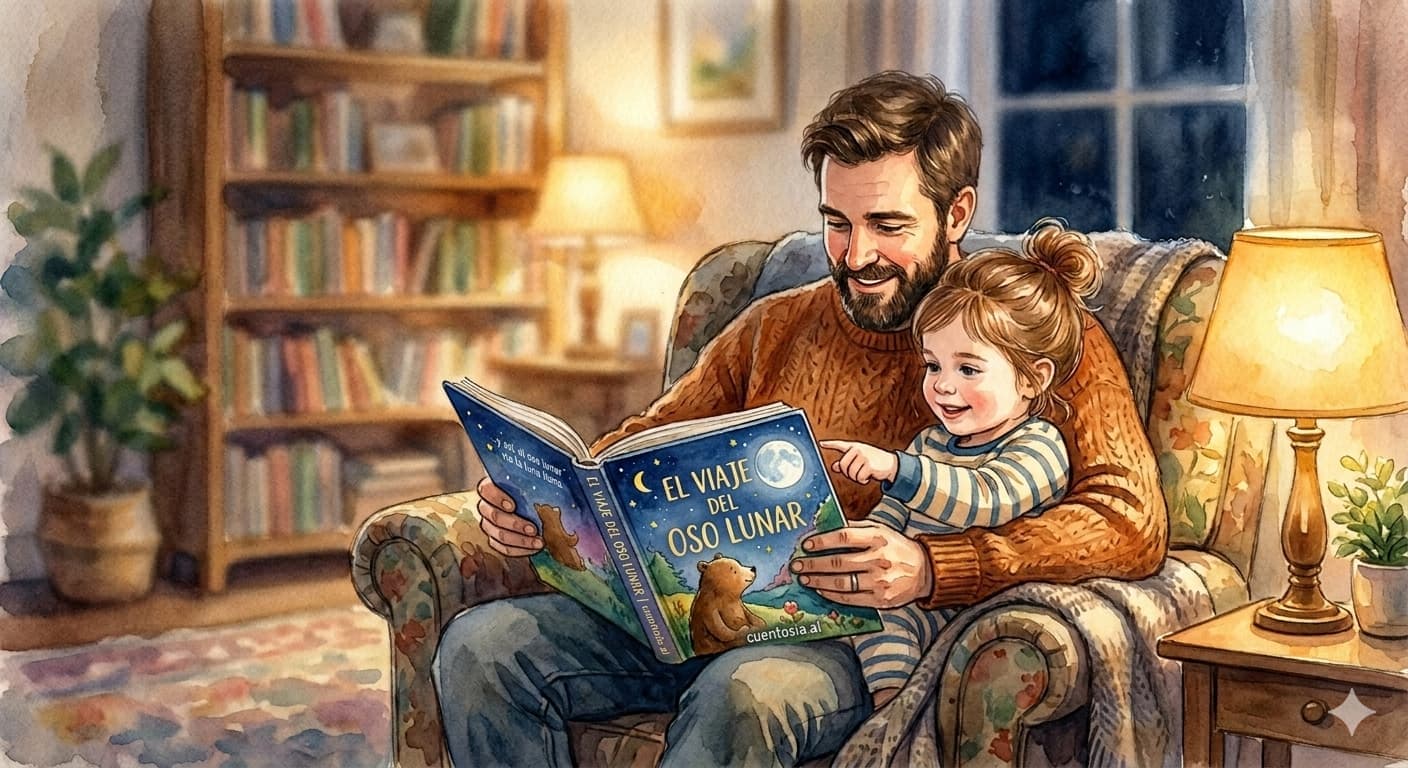
There is something that happens when a child hears a story in which they are the protagonist. Attention shifts. Eyes open a little wider at first ("is that me?") and then close more easily, because the story feels safe, close, their own.
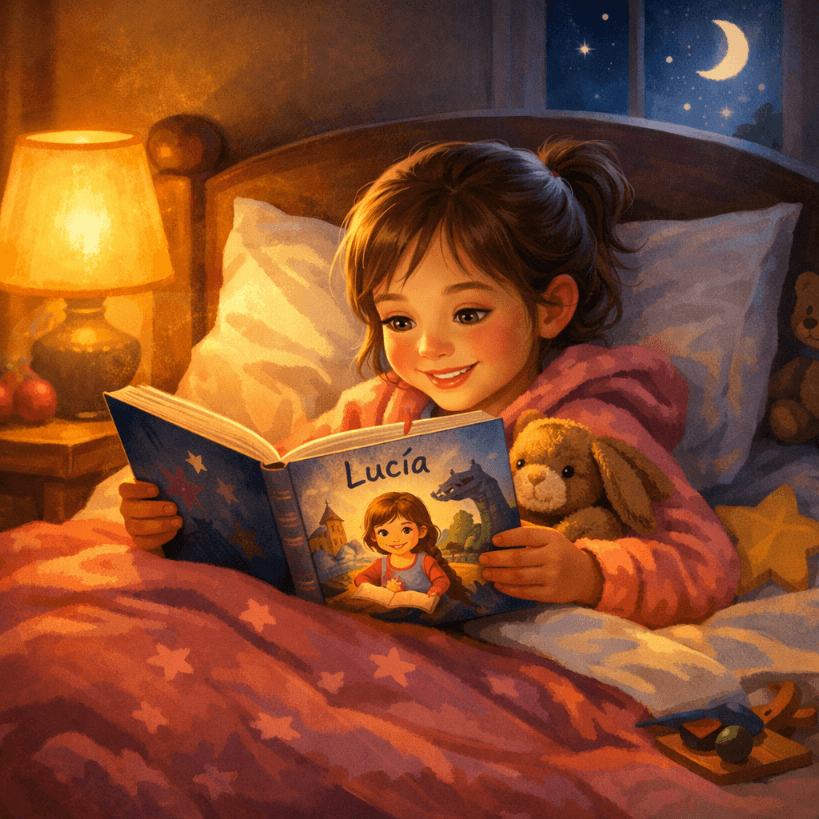
Personalised bedtime stories have specific advantages over generic stories in the context of the sleep routine. When the child recognises themselves in the illustrations, emotional identification is immediate and the calming effect is amplified — in fact, studies show that children remember more when they are the protagonists of the story. Moreover, with their name and likeness in the story, the child associates it with something of their own — something that belongs to them — which reinforces the sense of security they need to fall asleep peacefully. And perhaps most practically: a personalised story does not "wear out". The child wants to hear it again and again precisely because they see themselves in it, which is perfect for the routine because repetition is part of the mechanism.
Create a bedtime story tonight
With your child's real photos turned into illustrations. Ready in 5 minutes.
Start your bedtime story ritual tonight →7 practical tips for reading stories that invite sleep
How you read matters as much as what you read. These small adjustments make a big difference.
1. Slow down progressively. Start at a normal pace and gradually slow down as the story continues. By the end you should be speaking very slowly, almost whispering.
2. Lower your volume gradually. Like the pace, your voice should decrease in volume. The child will need to concentrate more to listen, which paradoxically relaxes them.
3. Pause between pages. Do not rush. A pause of 3–5 seconds between pages lets the story settle and allows drowsiness to advance.
4. Describe the illustrations calmly. Instead of just reading the text, linger on the images: "Look how night is falling… the stars are beginning to appear…" This creates mental visualisation that induces sleep.
5. Use physical contact. Stroke the child's hair or gently touch their back as you read. The combination of voice and touch is tremendously relaxing.
6. Do not force attention. If the child closes their eyes while you are reading, keep reading a little more softly and then stop. Do not ask "are you asleep?" — if they were, they no longer are.
7. Be consistent with the timetable. Most important of all. Reading at the same time every night is more effective than reading at any time. The body has an internal clock and the routine calibrates it.
Frequently asked questions
From what age can I start reading bedtime stories?
From birth. Babies do not understand the words, but they do understand your voice, your rhythm and your presence. From six months you can start incorporating books with large images and textures.
How long should the story last?
Between 5 and 15 minutes is ideal. Enough to create the moment of connection and relaxation, but not so much that the child stays awake waiting for the end.
Is it bad to read the same story every night?
On the contrary, it is beneficial. Repetition is a fundamental learning tool and gives children security. Over time you can naturally introduce variations or new stories.
Can I use an audiobook instead of reading myself?
Yes, audio stories are a valid alternative, especially for older children. Ideally combine both formats: your live voice has a stronger emotional effect, but a well-narrated audio story can work perfectly on nights when you are exhausted.
What if my child is too old for stories?
No child is too old for a reading moment before bed. What changes is the format: from the age of 8–9 they can read on their own, listen to audio stories, or share reading turns with you. The benefit of switching off before sleep has no expiry date.
What advantage does a personalised story have over a standard one?
When the child sees themselves as the protagonist of the story — with their name, their face turned into an illustration — emotional identification is much greater. This amplifies the calming effect and makes the child ask to repeat that story again and again, which is perfect for the routine. To go deeper, we recommend reading why personalised stories work better according to child psychology.
Cuentosia.ai is a personalised story platform that uses artificial intelligence to transform real photos into artistic illustrations. Available in English, Spanish and French.