Birthday Gift Ideas
The Birthday Gift Your Child Will Ask to Read Again and Again: Why a Personalised Story Beats Any Toy
Another birthday party, another pile of presents. By next month, half those toys will be forgotten at the back of a cupboard. There's one gift that bucks the trend — and the science behind it is compelling.
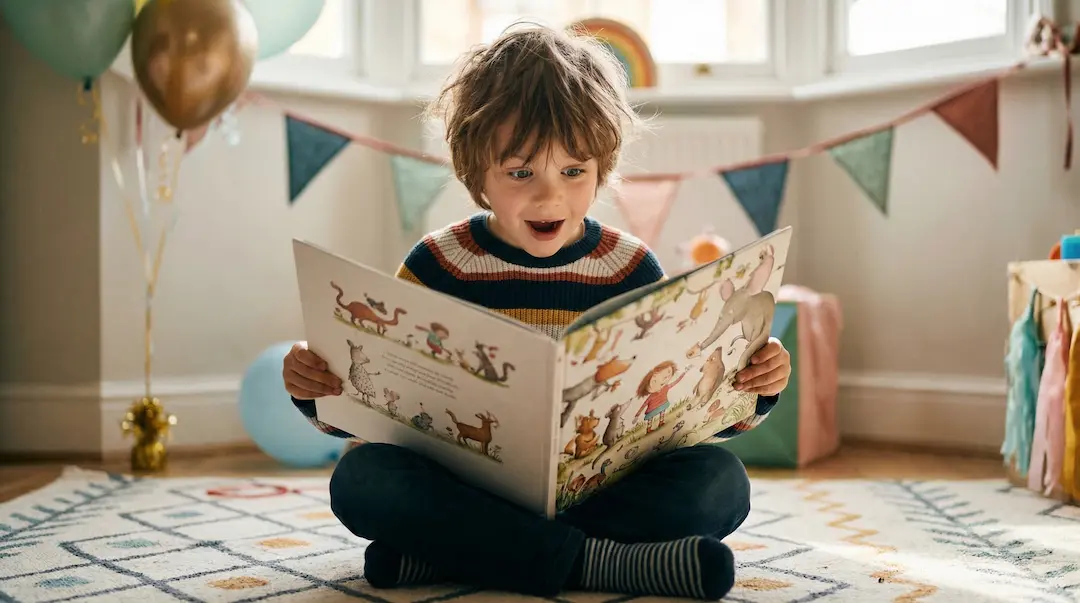
The psychology behind a birthday gift your child will ask for again
Most birthday gifts follow a predictable arc: excitement on the day, enthusiasm for a week or two, then slow abandonment. Child psychologists have a name for it — hedonic adaptation. The brain habituates to new stimuli, and what felt thrilling on Saturday morning feels ordinary by the following weekend.
A personalised storybook where your child is the hero sidesteps this entirely. It does not compete with toys — it operates in a different category of experience altogether.
Research finding: Dr Natalia Kucirkova found that personalised books generate significantly more smiles, laughter, eye contact, and verbal interaction between parent and child than non-personalised books — including the child's own current favourite (Kucirkova, Messer & Whitelock, 2013).
The reason is structural: when a child sees their own name and face in the story, the brain does not process it as fiction. It processes it as memory in the making.
Why most toys are forgotten by February
UK families spend an average of £800 per month per child on child-rearing costs (ONS, 2024). A significant portion goes on toys, games, and birthday gifts — yet according to the British Toy & Hobby Association (BTHA), the average toy loses a child's active interest within six weeks of receipt.
Which? consumer research corroborates this: in a survey of 2,000 UK parents, 67 % reported that their children had toys bought in the last 12 months they no longer played with. The environmental and financial cost is substantial — an estimated 8,500 tonnes of plastic toys go to landfill in the UK each year.
£800
Average monthly child-rearing cost per child in the UK (ONS, 2024)
67 %
UK parents with toys bought in the last year that are no longer used (Which?, 2023)
6 weeks
Average time before a toy loses active interest (BTHA consumer data)
British child development researchers note that the problem is not lack of imagination — it is overstimulation. When children receive too many objects at once, each individual item loses significance. The gift pile becomes noise.
Key insight: Child psychologists consistently advise that fewer, more meaningful gifts produce better outcomes for wellbeing, creativity, and frustration tolerance. The question is not "what toy shall I buy?" — it is "what will actually matter?"
How your child's brain processes a story about themselves
The self-reference effect (Rogers, Kuiper & Kirker, 1977) is one of the most replicated findings in memory psychology: the brain encodes and recalls information significantly better when it is connected to the self. A meta-analysis of over 100 studies confirms the effect holds robustly across age groups (Symons & Johnson, 1997).
In children specifically, researcher Sheila Cunningham demonstrated in Child Development (2014) that the self-reference effect is already active at age four. A 2025 study in Nature Communications suggests the roots appear as early as age two.
In practice: A simple self-referencing instruction improves children's recall performance by 20 %. When your child opens a book and sees themselves as the hero, their brain activates deeper memory circuits than any generic toy could reach.
This is also why personalised books get reread. Each rereading reinforces the family bond and the memory of who gave the gift — making it the rare present that actually grows in value over time.
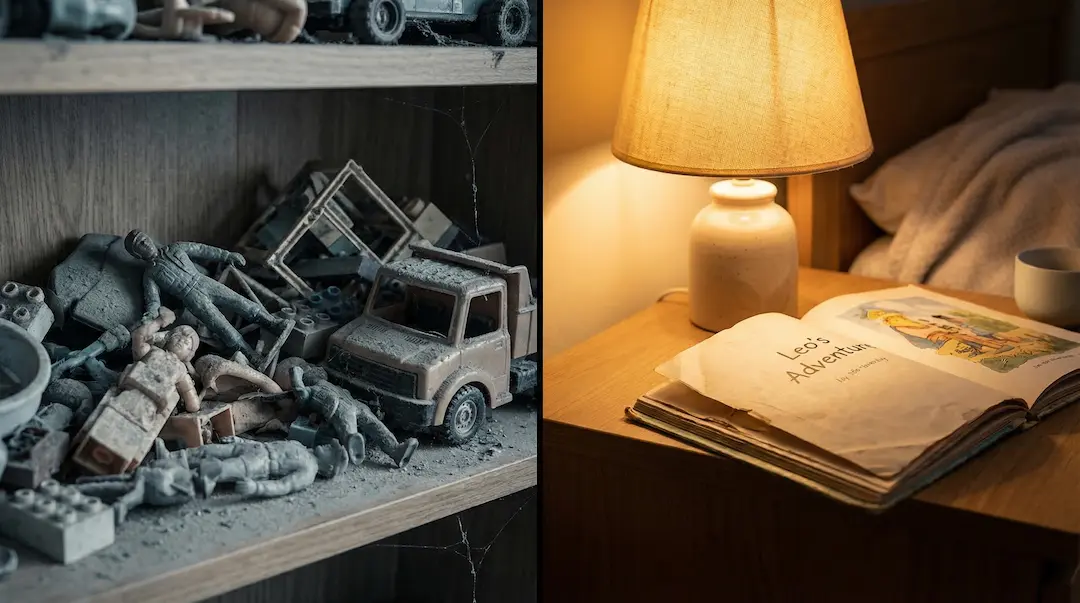
Personalised story vs toy: the comparison nobody makes
From photos to finished book in minutes
Cuentosia.ai turns a photo into a fully illustrated, AI-written storybook in under five minutes. No design skills needed. No account required to preview.
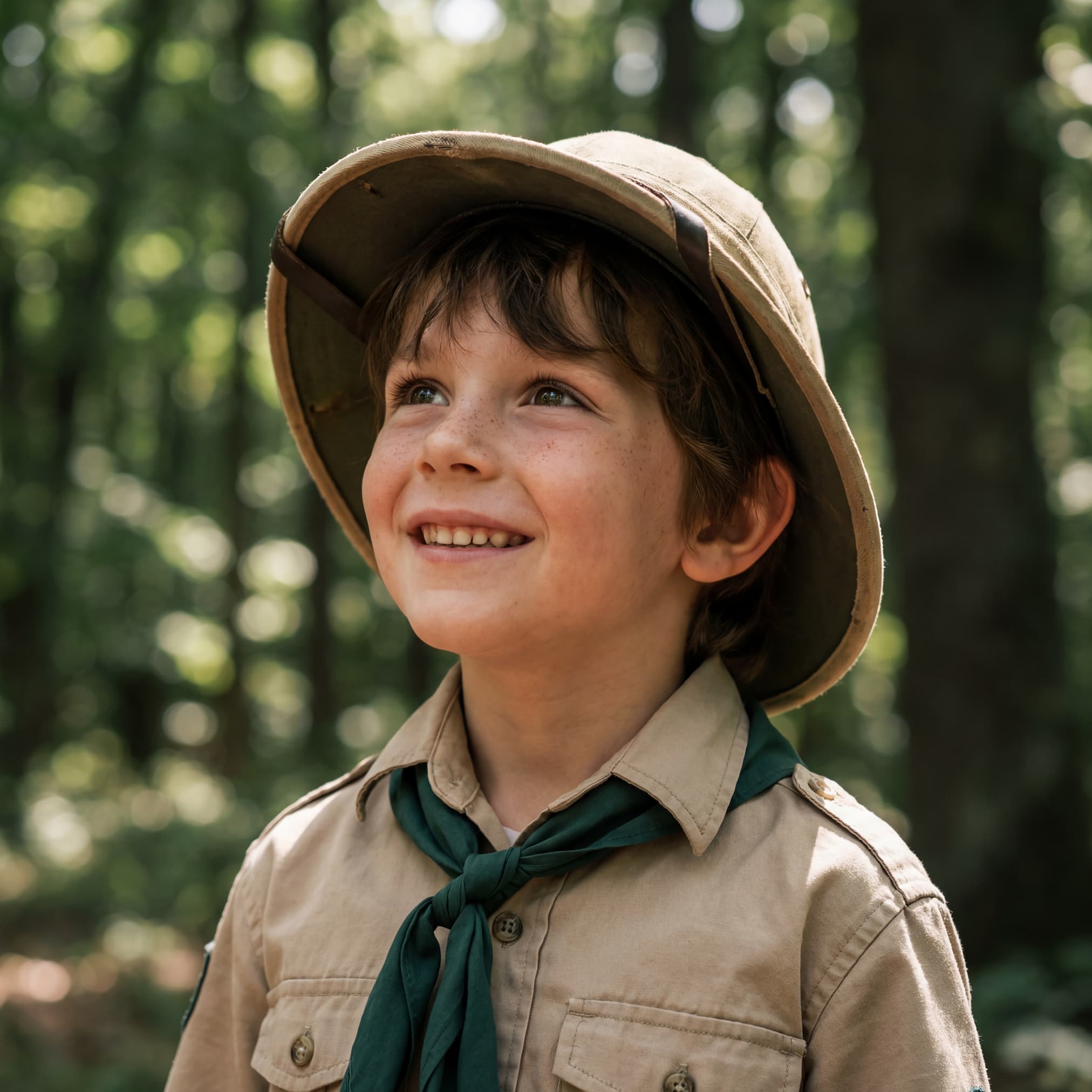
Upload a photo of the birthday child
A clear frontal photo in good light. Cuentosia.ai transforms it into a real artistic illustration — not a generic avatar.
Choose the adventure and illustration style
25 illustration styles and unlimited themes. Pirates, space, fantasy, mystery, classic fairy tales — whatever the child loves most.
Add characters and personalise
Siblings, parents, grandparents, the family pet, classic public domain characters. Edit the text and add a birthday dedication.
Pick your format and surprise them
Printed hardback for maximum impact. PDF for instant delivery. Audiobook for bedtime. The first story is free to preview.
Choose your format: digital or print
PDF — instant delivery
Generated in five minutes. Perfect if the birthday is today or tomorrow. Share via WhatsApp or email. Print at home on A4 if you like.
Printed hardback book
Professional print quality. The book the child holds, keeps on their shelf, and shows their friends. Allow 7–14 working days for UK delivery.
Audiobook
AI-narrated in a warm voice. Play it at bedtime. The child hears their own name read aloud — a surprisingly powerful experience.
Tip: If the party is this weekend, order the PDF now and let the printed hardback arrive as a second surprise the following week. Two moments of magic instead of one.
Scientific references
- Rogers, T. B., Kuiper, N. A., & Kirker, W. S. (1977). Self-reference and the encoding of personal information. Journal of Personality and Social Psychology, 35(9), 677–688.
- Symons, C. S., & Johnson, B. T. (1997). The self-reference effect in memory: A meta-analysis. Psychological Bulletin, 121(3), 371–394.
- Cunningham, S. J., et al. (2014). The self-reference effect on memory in early childhood. Child Development, 85(2), 808–823.
- Kucirkova, N., Messer, D., & Whitelock, D. (2013). Parents reading with their toddlers: The role of personalisation in book engagement. Journal of Early Childhood Literacy, 13(4), 455–470.
- Van Boven, L., & Gilovich, T. (2003). To do or to have? That is the question. Journal of Personality and Social Psychology, 85(6), 1193–1202.
- British Toy & Hobby Association (BTHA, 2024). UK toy market report — consumer interest data.
- Which? (2023). Survey of 2,000 UK parents on toy usage and waste.
- Office for National Statistics (ONS, 2024). Family spending in the UK — average monthly cost per child: £800.
Frequently asked questions
Is a book really enough of a birthday present?
A printed hardback featuring your child's face as the story's hero has more emotional impact than most toys. It is not "just a book" — it is their book, unique in the world.
Can I combine it with another gift?
Absolutely. Many parents give the story as the "special gift" alongside something smaller. The book will be the one they remember.
Will I have it in time for the party?
The PDF is ready in five minutes, so you'll always make the deadline. For a printed hardback, allow 7–14 working days for UK delivery. If time is tight, send the PDF first and let the printed book arrive as a second surprise.
What if I'm buying it for a friend's child?
You just need the child's name and a photo — ask the parents. In five minutes you have a gift that looks far more thoughtful than anything off a shelf.
Are the child's photos kept securely?
Yes. Cuentosia.ai deletes photos immediately after generating the illustrations. They are never stored or used to train any AI model. Full privacy guaranteed.
Give them a story they'll reread 100 times
A personalised storybook where your child is the hero, illustrated with their real photo. The birthday gift that ends up on the shelf for years — not the bin by February. Free to preview, no card needed.
Want to know more? Read why personalised stories work better according to child psychology, why your child remembers more when they're the protagonist, and how to use stories to manage emotions by age.